Version v26.04

Warning

Update to version v26.04 must be performed according to special instructions.

Version v26.04 adds: automatic packet capture in General Protection, ISN-agent improvements, dynamic sFlow sampling, Flow/SNMP ratio page in Collector, GRE traffic processing distribution mode across cores, traffic bypass mode above the license bandwidth, traffic graphs from internal network in protection policies, updated PostgreSQL version.

The functionality of ACL, ACL6, ACLI, LACL, LACL6, SCAN, ATLS, ITLS, SPLI, DNS, DNS6, TCP6, USF, BPF, LIM countermeasures has been expanded, as well as Collector, HPD, PCAP, “Overview” page, “Flow Analysis” page, “Event Log”, and named filter rule sets.

Multiple UX improvements made.

Changes in v26.04

HPD. Host Protection Detector

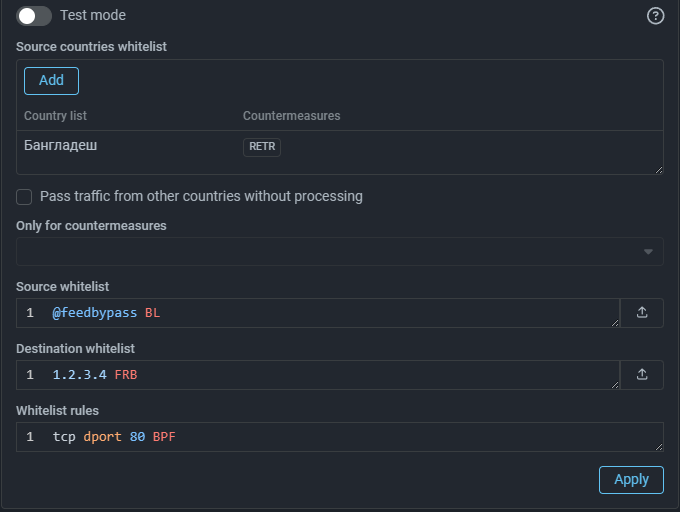
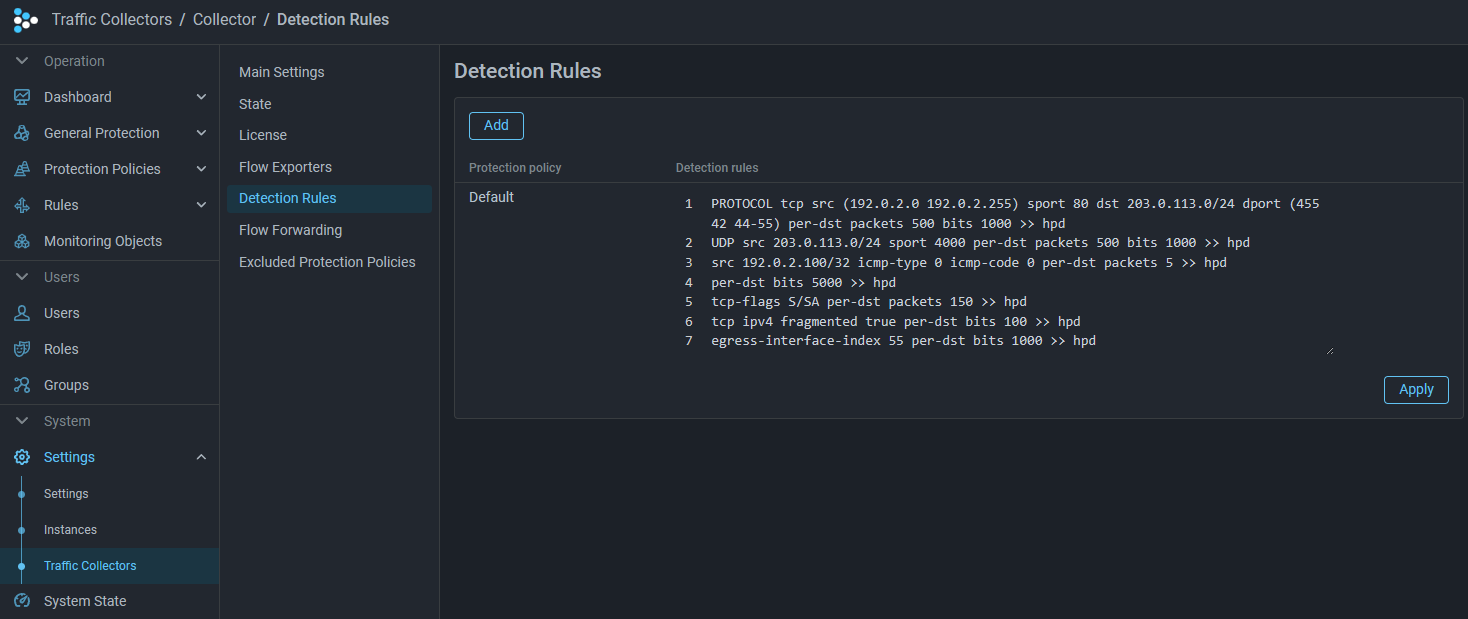
Added ability to mark traffic in HPD based on Collector data

Now the Host Protection Detector can mark traffic to IP addresses for which a threshold exceedance has been detected on the Collector. To enable this, set the flag “Use collector detection based activation” in the HPD panel and configure traffic collection rules on the “Detection Rules” page.
Added logging of HPD activation reason

Now the Host Activation Log stores not only the fact of activation of the mechanism for a specific IP address, but also the reason for activation and the rule, if present.

instance_id,instance_name,created_at,action,dst_ip,reason,rule
1,Mitigator0,2022-09-02 10:44:31.53622 +0000 UTC,added,10.0.2.254,LimitBps,BITS 200 ACL udp
1,Mitigator0,2022-09-02 10:44:41.51245 +0000 UTC,added,10.0.2.254,UntrustedSource,
Increased maximum bit limit
Now in rules and counter for other packets you can set a limit up to 10 Gbps.

Autodetection

Added test mode disabling by the autodetection mechanism

Added <element>.TestMode.* thresholds that control the countermeasure’s test mode operation. The logic of their operation is identical to that of thresholds without TestMode in the name, except for naming nuances:

  • For bidirectional thresholds, the relationship Xxx.TestMode.Yyy.On < Xxx.TestMode.Yyy.Off typically holds, because it makes sense to turn off test mode when the threshold is exceeded, and turn it on when traffic drops below a certain mark.
  • In Diff threshold sets for absolute change per cycle, OnFactor and OnMin* are present instead of OffFactor and OffMin*, having the same meaning but applicable to enabling test mode.
  • In Ratio threshold sets for relative change per cycle, Xxx.TestMode.Yyy.Ratio.On < Xxx.TestMode.Yyy.Ratio.Off, because it makes sense to turn off test mode when traffic grows sharply.

PCAP

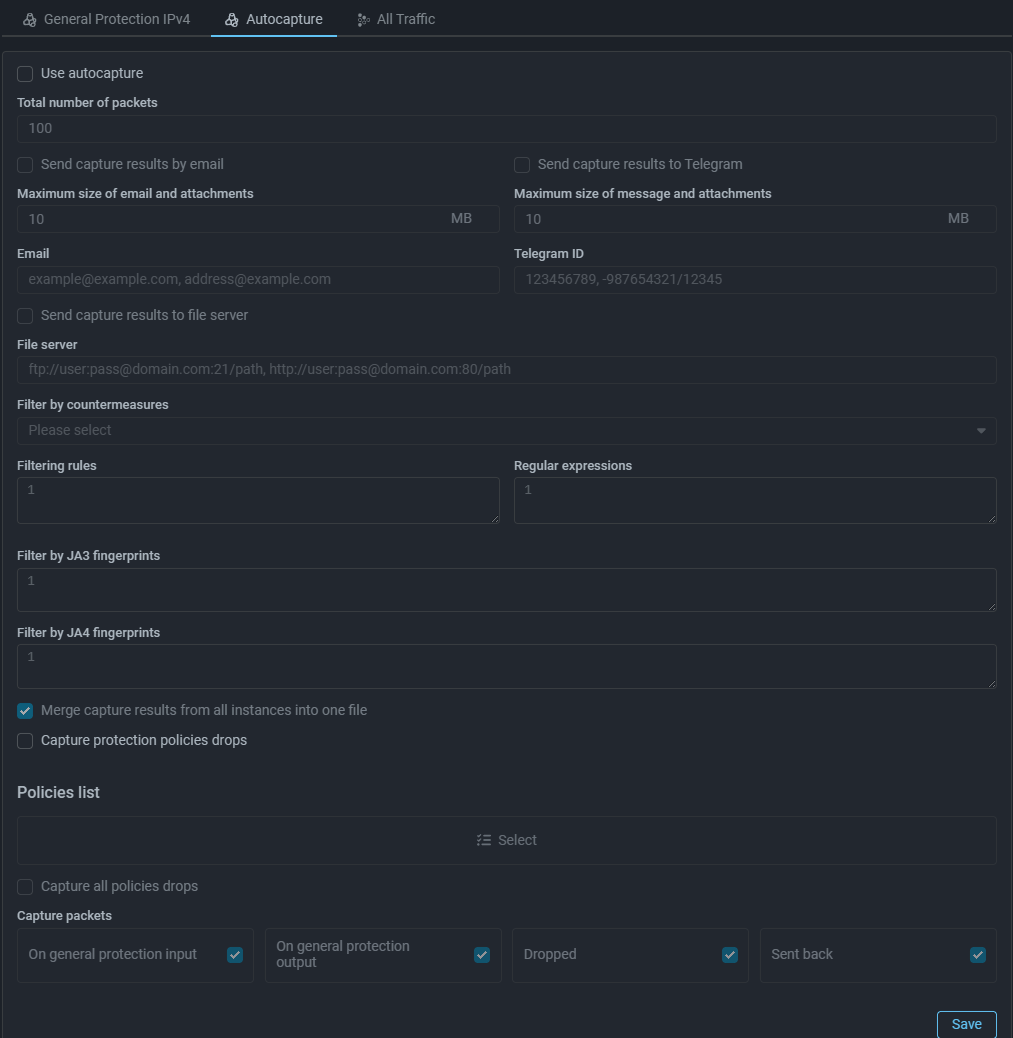
Added automatic packet capture in General Protection

Automatic packet capture has been added to General Protection IPv4 and IPv6, similar to auto-capture in protection policies.
Changed automatic PCAP deletion time
Now the capture file is deleted 24 hours after the last capture activity, i.e., after the last packet was captured. Previously, the 24-hour period was counted from the moment the packet capture started.

Protection Policies

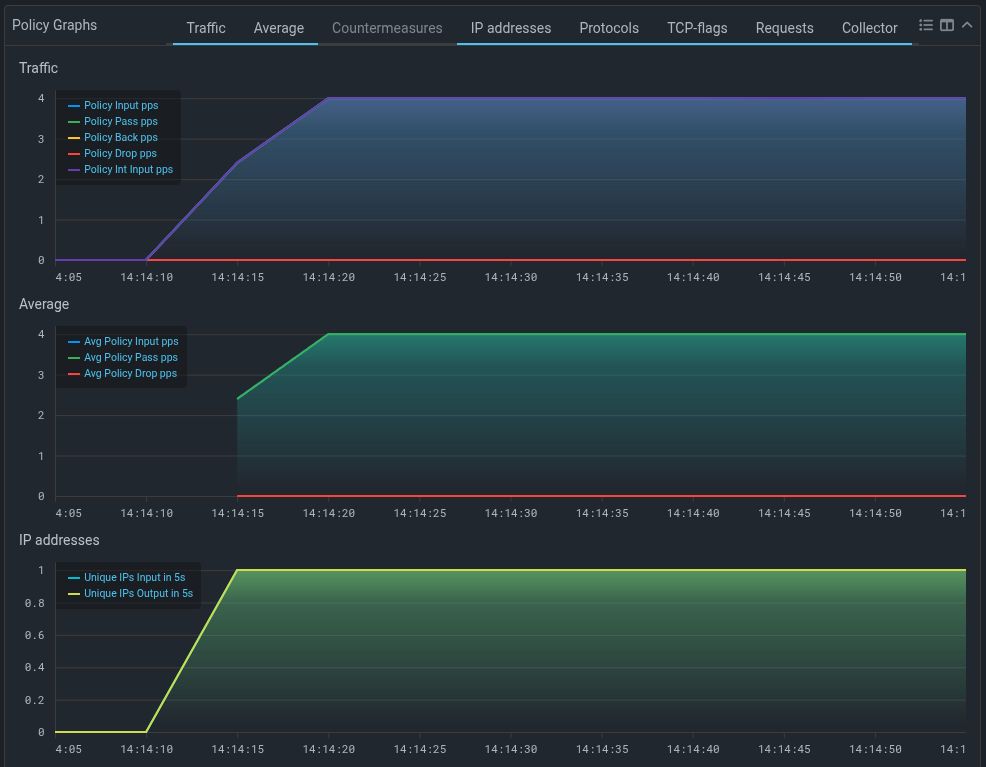
Added traffic graphs from internal network in protection policies

Now on protection policy graphs you can see curves for traffic from internal network, associated with this policy.
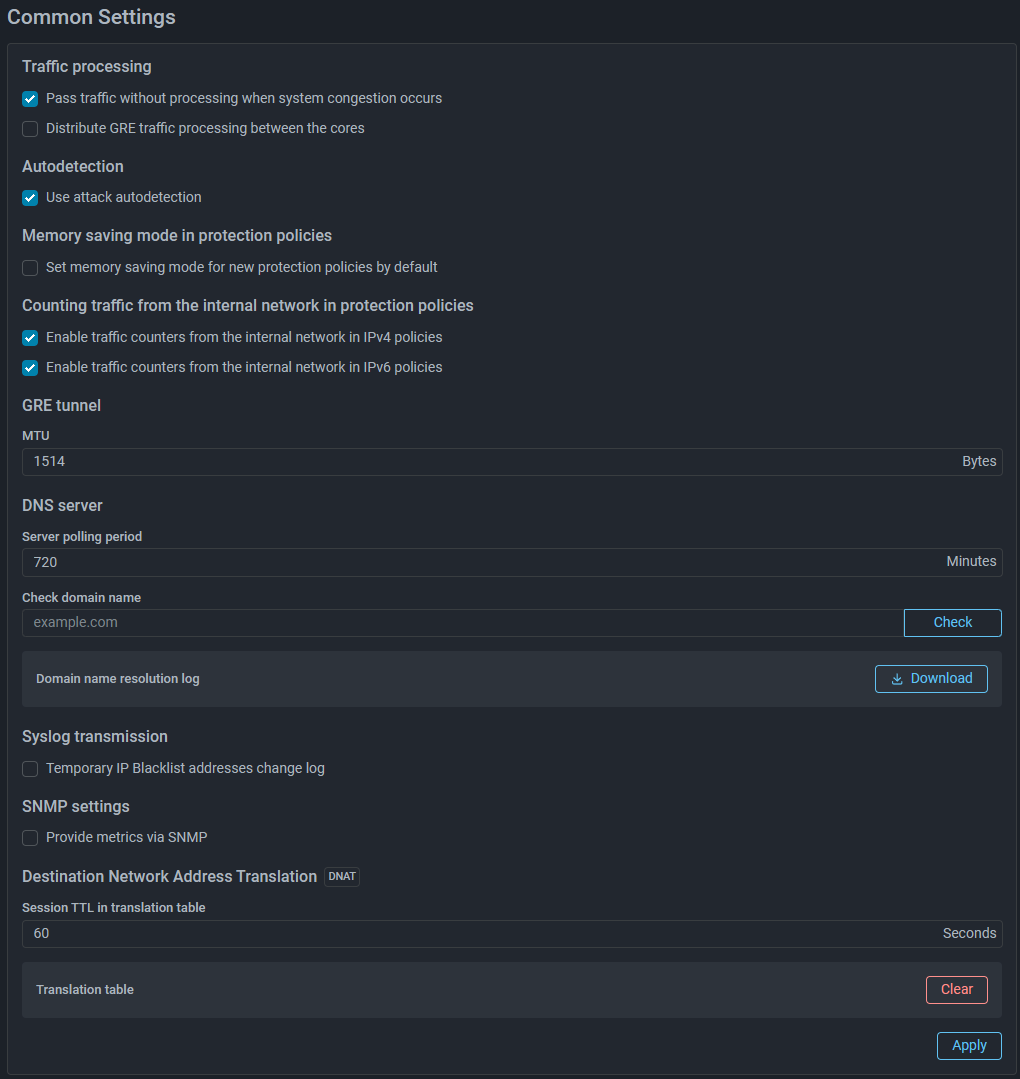
Enabling counting of traffic from internal network for display on graphs is done on the “Common Settings” page in system settings and affects all protection policies.
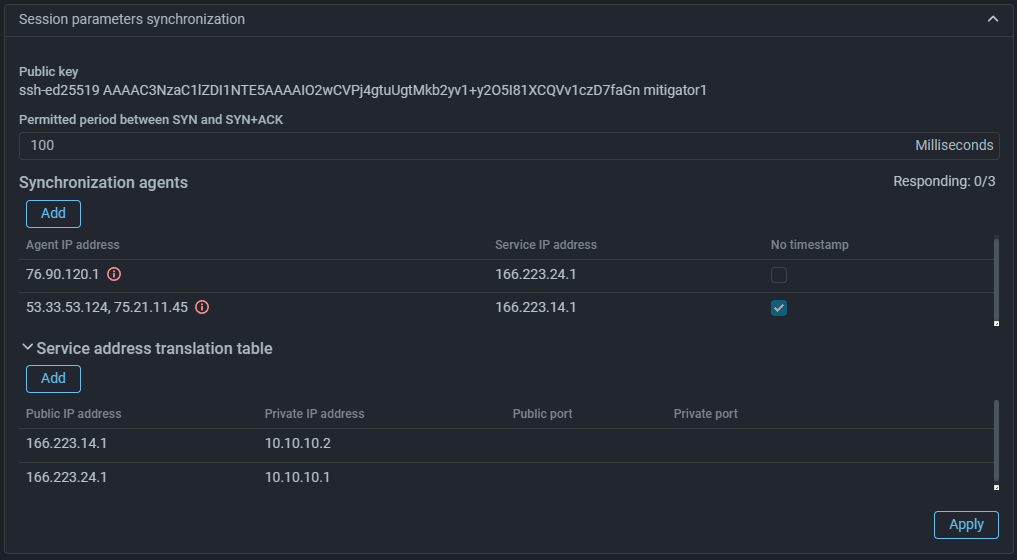
Added TCP Timestamps option check by ISN-agent

Now when checking SYN+ACK packets, you can select processing mode without taking Timestamp into account.

Since not all servers send Timestamp, the check can be disabled by setting the flag “No timestamp” in the session parameter synchronization settings for a specific server. The parameter applies to all servers listed in the line. If you need to apply it to only one server, you need to move it to a separate entry. If the synchronization agent is used in multiple protection policies, and in at least one of them the “No timestamp” parameter is set, it will be applied in all policies.
Added support for ISN synchronization for IPv6 countermeasures

Countermeasures

BPF. Removed VLAN ID functions in mitigator_bpf.h

VLAN ID functions have been removed from the public API of BPF programs. If these functions were used in your BPF programs, when rebuilding them with the new mitigator_bpf.h header, you need to add these functions to the program source code:

#define VLAN_ID_MASK 0x0fff

/** @brief Get VLAN ID from 802.1q header. */
LOCAL uint16_t
vlan_get_id(const struct VlanHeader* vlan) {
    return bswap16(vlan->control) & VLAN_ID_MASK;
}

/**
 * @brief Set VLAN ID in 802.1q header.
 *
 * If you don't need to keep rarely used DEI and PRI, a faster alternative is:
 * @code
 * vlan->control = bswap16(id);
 * @endcode
 */
LOCAL void
vlan_set_id(struct VlanHeader* vlan, uint16_t id) {
    uint16_t bits = vlan->control & ~bswap16(VLAN_ID_MASK);
    vlan->control = bswap16(bswap16(bits) | id);
}
DNS. Added graphs by request types
A “Types” tab has been added to the DNS countermeasure graph, showing the rates of DNS requests with different types.
USF. Changed tracked sessions graphs

Now the countermeasure graphs display the number of sessions observed both inside and outside the recent session ignore depth window:

  • USF Allowed sessions — number of tracked sessions that were observed outside the recent session ignore depth window;

  • USF Ignored sessions — number of tracked sessions that were observed only inside the recent session ignore depth window.

SCAN. Added the ability to set the number of unique destination IP addresses and ports
Previously, the countermeasure triggered upon detecting ten destination IP addresses or ports within a specified time. Now the trigger threshold can be set in the range from 1 to 50.
ACL. Added icmp6 alias support in rules
Now in rules for HPD, ACL, FRAG, FACL, RETR, FRB, LACL, ACLI, DNAT you can specify alias icmp6 instead of protocol 58.
ACL. Added BYPASS and COUNT BYPASS actions
The BYPASS action passes traffic matching the rule to the protection policy output for ACL in policy or to system output for ACL in General Protection. The COUNT BYPASS action additionally counts the passed traffic and displays it on the graph.
ACL6. Added BYPASS and COUNT BYPASS actions
ACLI. Added BYPASS and COUNT BYPASS actions
LACL. Added BYPASS action
LACL6. Added BYPASS action
ATLS. Added support for TLS FALLBACK scenario
SPLI. Added graph of authenticated IP addresses count
ITLS. Added autodetection mechanism support
DNS6. Added support for operating modes with session parameter synchronization
TCP6. Added support for operating modes with session parameter synchronization

sFlow

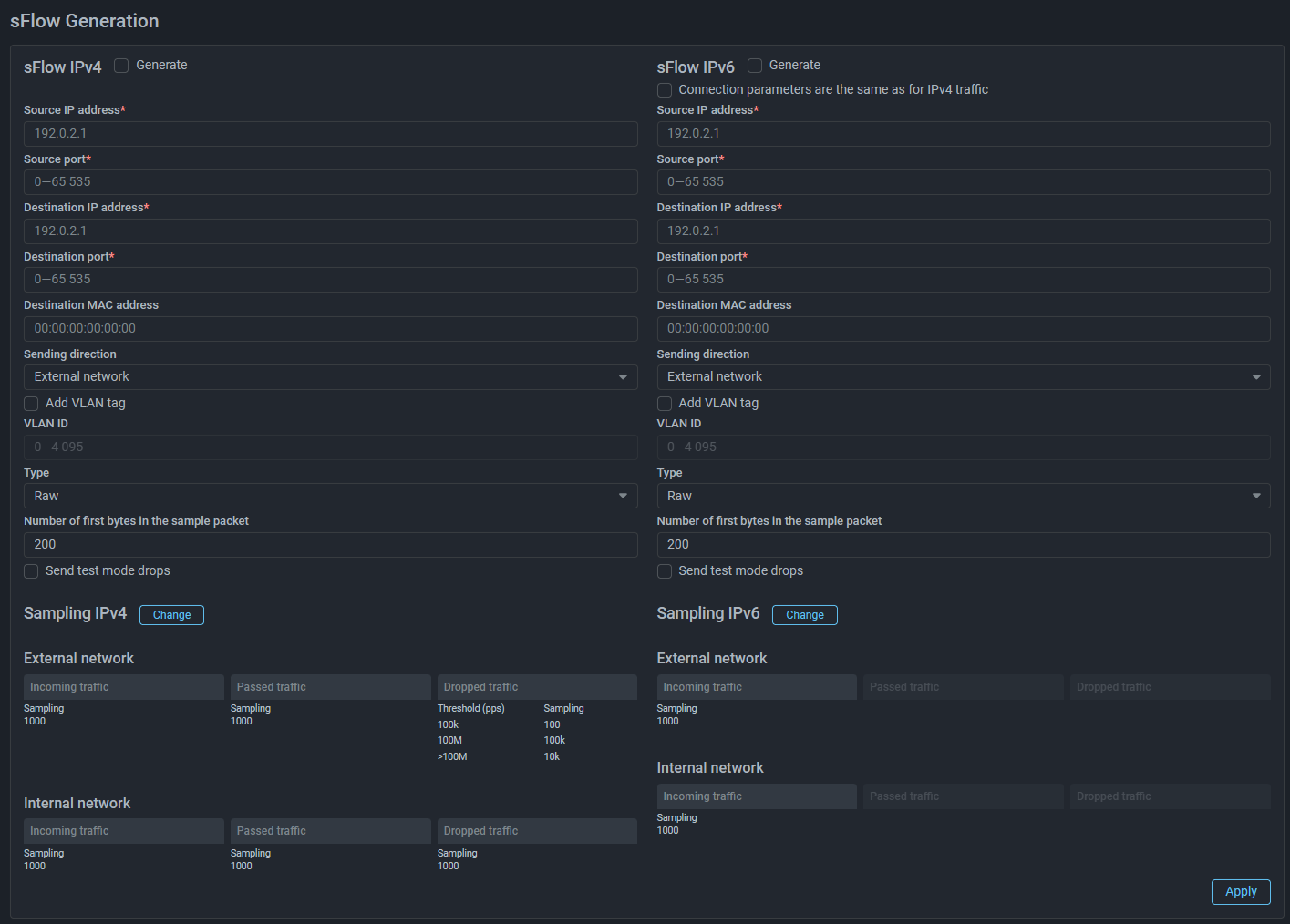
Added dynamic sampling when sending sFlow

Now you can set different sFlow sampling values for different traffic rates. When the set rate threshold is exceeded, the sampling value changes automatically. You can set up to four sampling values for different traffic rate ranges.
Collector

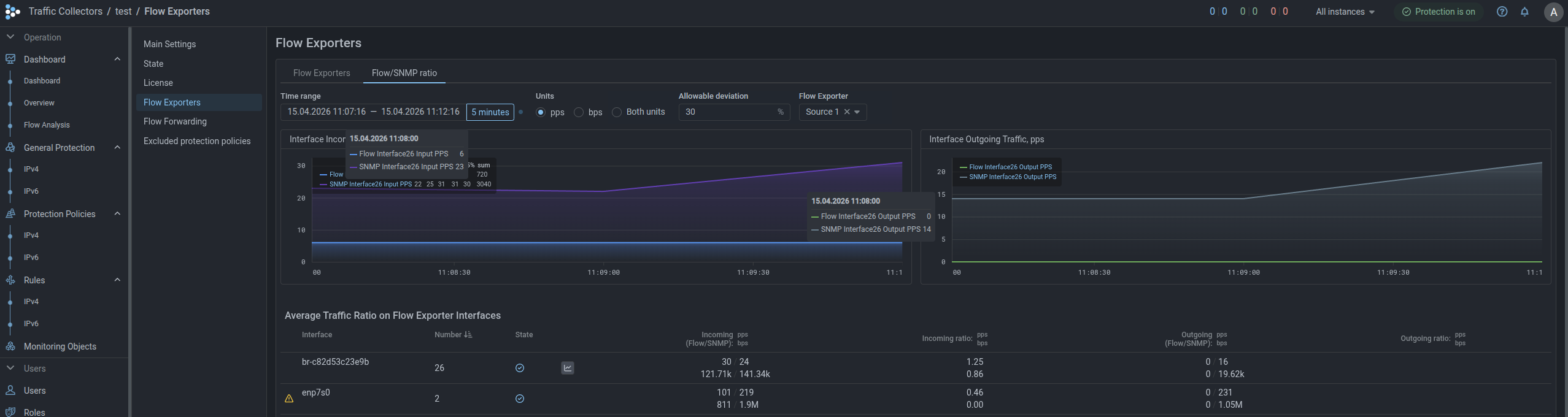
Added page for displaying average traffic ratio on Flow source interfaces

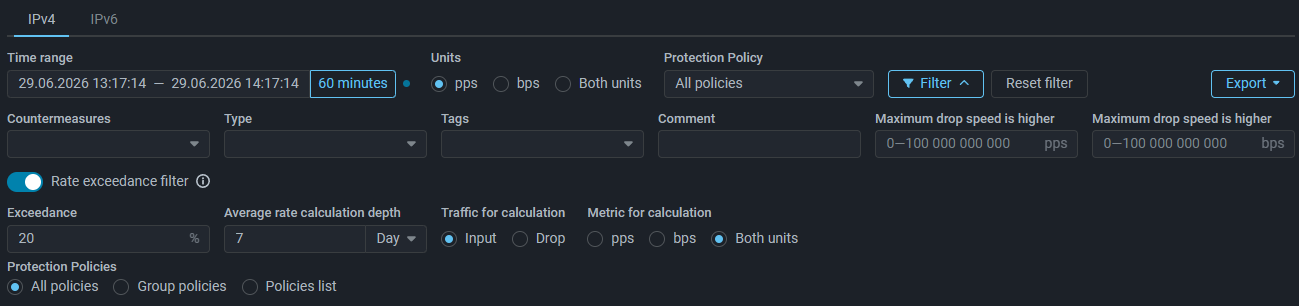
A “Flow/SNMP Ratio” tab has been added to the “Flow Exporters” page, displaying traffic statistics on all source interfaces obtained via Flow and SNMP.

The tab also specifies the “Allowable deviation”, which determines how much the ratio of the average traffic rate obtained via Flow to that obtained via SNMP can deviate from one. For example, with a tolerance of 10%, a ratio between 0.9 and 1.1 is considered normal.

If the deviation in the ratio of average traffic rate values ​​received via Flow to those received via SNMP exceeds the acceptable limit, this may indicate that the system is configured incorrectly or that data is not being received. For such interfaces, appropriate indication appears in the row.
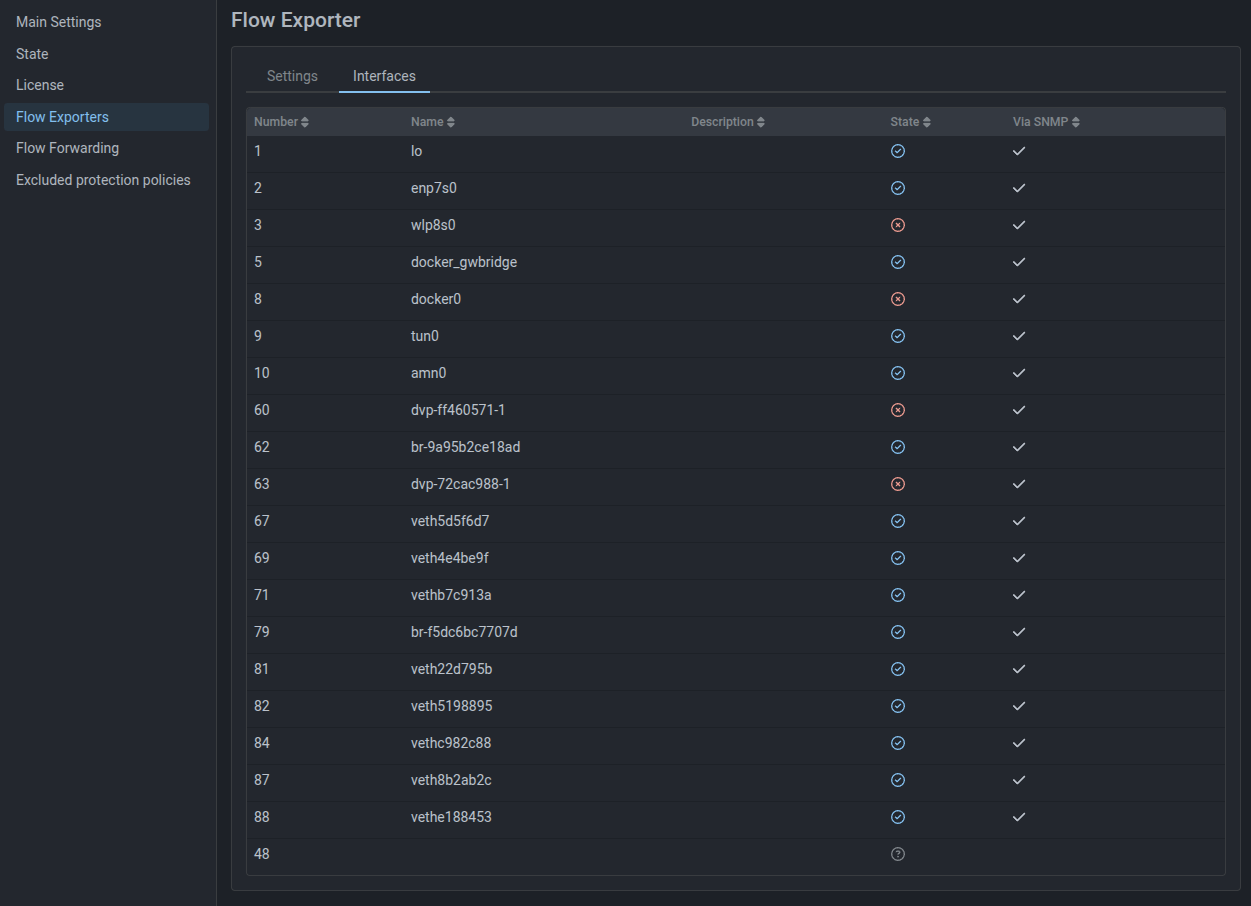
Flow source interfaces table moved to a separate tab
Added new Flow source interface status

Now in the “Status” column of the Flow source interfaces table, the interface displays one of three statuses based on SNMP data:

  • interface status UP;
  • interface status DOWN;
  • interface status unknown.

Logan

Added negation in regular expressions

Now in rules for request, referer and user-agent components you can specify negation using the “not” keyword.

Examples:

# Block IP address for 300 seconds that requested any URI from web-server except
# `/api/some/magic/uri`:

block 300 not request /api/some/magic/uri

# Block IP address for 600 seconds that received
# request containing any value other than 123 in User-Agent header:

block 600 not user-agent 123

# Create entry in event log when receiving from IP address
# request containing any value other than "^https://domain" in Referer header:

alert not referer "^https://domain"

Core

Added mode for distributing GRE traffic processing across cores

When activating the “GRE Tunnel with External Service” function in instance settings, GRE traffic processing is by default performed on a single CPU core. If the flag is set, balancing across all cores will be performed. The setting is applicable only when using Mellanox network cards, for other network cards the setting is ignored.
Updated PostgreSQL version
Due to the PostgreSQL version update, updating MITIGATOR to version v26.04 must be performed according to special instructions.
Changed pgfailover configuration logic

Previously, pgfailover parameters were set in the command: of the pgfailover service in docker-compose.failover.yml. When updating the file, user changes had to be migrated manually.

Now pgfailover parameters are set via environment variables in .env, and a non-standard server list — in docker-compose.override.yml. For future updates, simply download the latest docker-compose.failover.yml.

DPDK has been updated to v26.03
Added bypass mode without processing for traffic above license bandwidth

ISN-agent

Updated ISN-agent for version v25.06+
An updated version of ISN-agent for Linux with support for additional instructions on kernel versions 6.12 and above has been published on Github. Update the ISN-agent if you are using kernel 6.12+.

Data Synchronization

Added DNAT support via active synchronization mechanism
Added support for the scenario where traffic of translated sessions passes through different MITIGATOR instances.
Added DNAT support via table synchronization mechanism
Added the ability to synchronize DNAT translation tables to improve fault tolerance.

Analytics Server

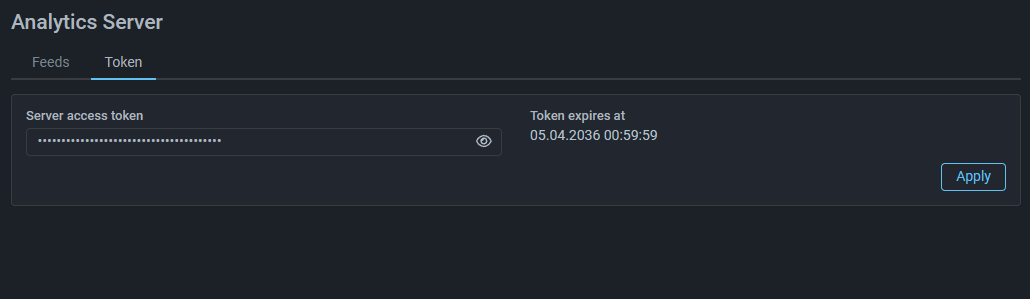
Added token expiration date indication for analytics server access

Roles and Permissions

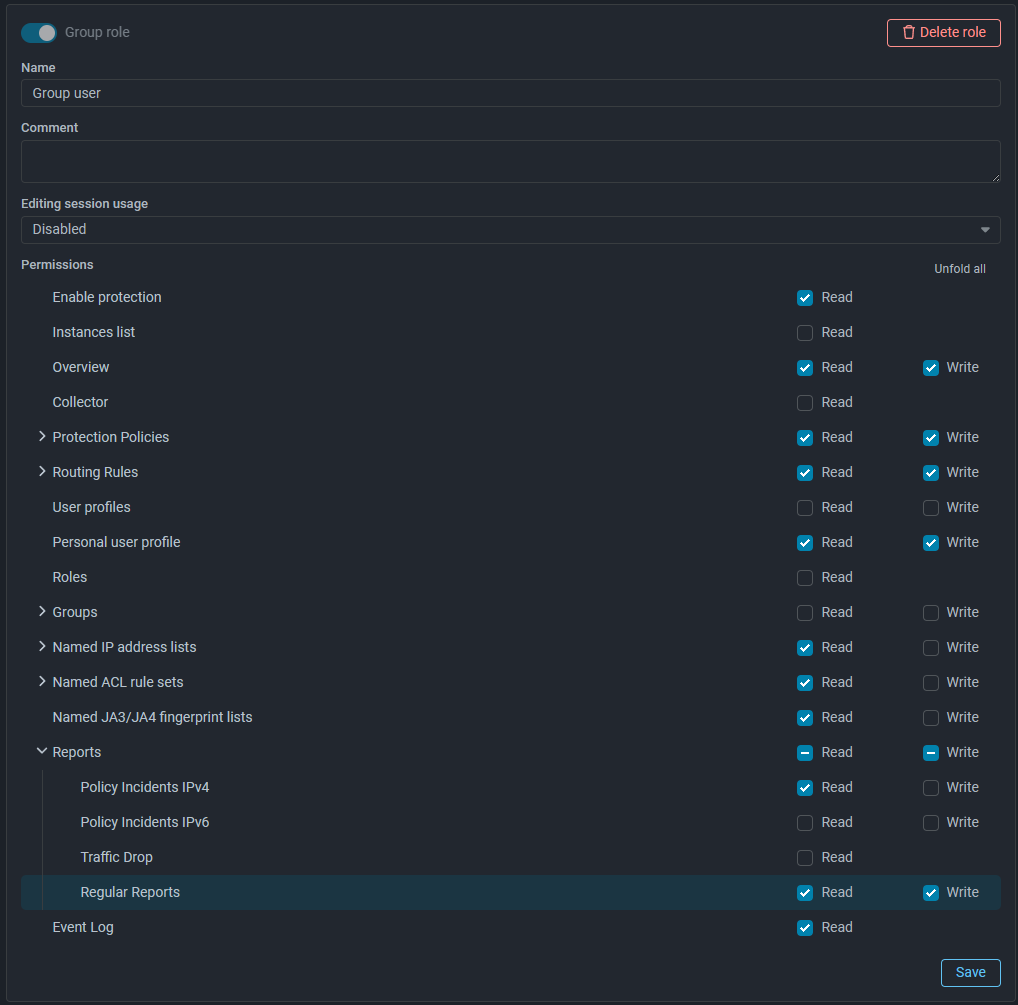
Added permissions for group users to create regular reports

Named Lists

Added size limit for rules in named ACL Rule Sets
The size of a named ACL rule set can not be larger than 10,000 bytes.
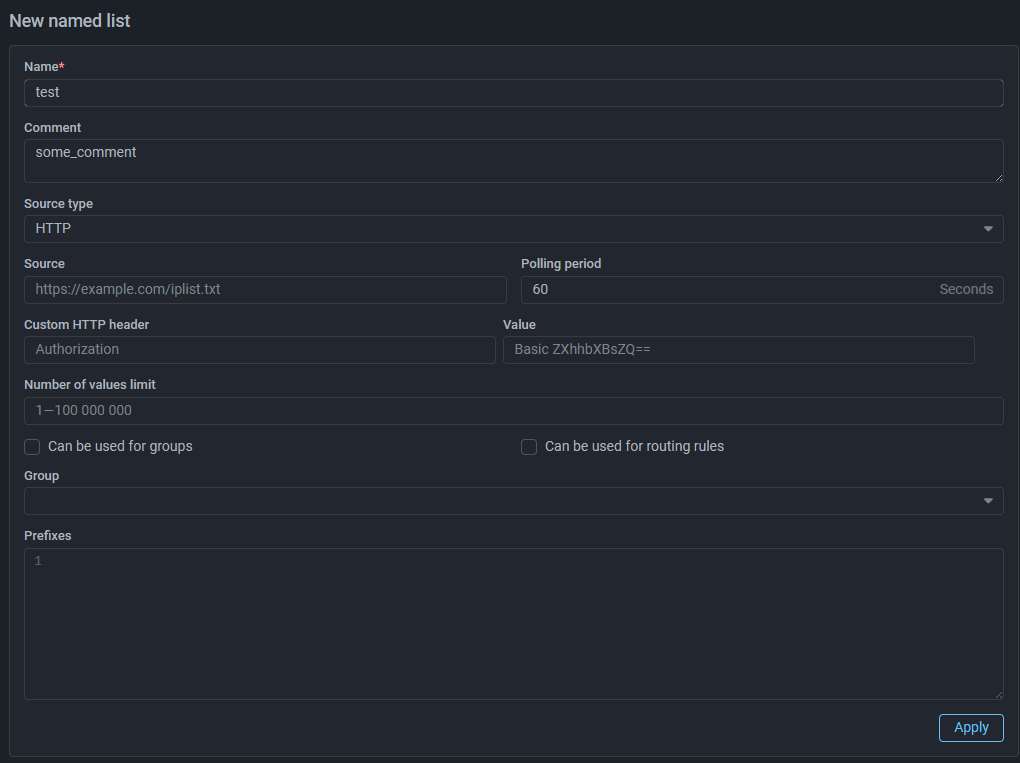
Added ability to specify custom HTTP headers when loading from an external source

You can now specify custom HTTP headers and their values in named list parameters, for example, for authentication when fetching data from an HTTP-type source.
"Overview" Page

Added ability to change tab order on "Overview" page

Previously tabs were sorted alphabetically, now by clicking the “Change tab order” button, you can move tabs.

"Flow Analysis" Page

Added widget category for building graphs on passed traffic
Added “Pass” widget category. Widgets in this category display sFlow from MITIGATOR on passed traffic.
Added widget with top by packet TTL

Event Log

Added logging of packet capture file paths
Now when placing packet capture result files on the file server, the paths to these files are recorded in the “Details” field of the event log.
Added token logging when ALERT action triggers in Logan
Now when ALERT action triggers in Logan rules, the token for which the rule triggered is recorded in the “Details” field of the event log.

Interface

Added ability to set threshold values with different decimal prefixes

To improve convenience of setting thresholds and simplify perception of already set ones, the ability to change decimal prefixes when specifying values has been added.

As an experiment, currently the functionality has been added to HPD, BPF, LIM and TAP interface, we plan to extend this change to all other mechanisms and countermeasures in the future.

Unified date and time order in fields displaying action execution time

Now in all interface elements where date and time of action execution were specified, the order is identical: yyyy-mm-dd HH:MM:SS.